

“Benchmarking an LLM on MMLU is cute. Running an autonomous agent for 72 hours until it forgets English and starts speaking Mandarin to your Docker daemon is an education.”
— Field Notes from the Token Trenches | #ModelTelemetry
I am thoroughly sick of artificial intelligence benchmarks. Every time a new model drops, the tech press breathlessly waves around radar charts and standardized math scores like they just discovered cold fusion. They want you to believe these frontier models are infallible digital gods operating in sterile, harmonious alignment.
Here in the real world, where we actually build software, reverse-engineer abandonware, and burn through personal credit lines to keep autonomous subagents from going rogue, working with these models is more like managing a psych ward staffed by eccentric geniuses. Some are cold-blooded corporate hitmen. Some are golden retrievers with severe ADHD. One is a token-guzzling supercomputer draining my local municipal reservoir, and another is a rusted-out 1998 Honda Civic that gets 40 miles to the gallon until it randomly blows a head gasket in Cantonese.
Here is my completely unvarnished, battle-tested field guide to what it’s actually like to live with every major AI model on the market today.
Anthropic: The Assassin, The Golden Retriever, and The Neglected Middle Child
Fable 5.1: The Cold-Blooded Hitman
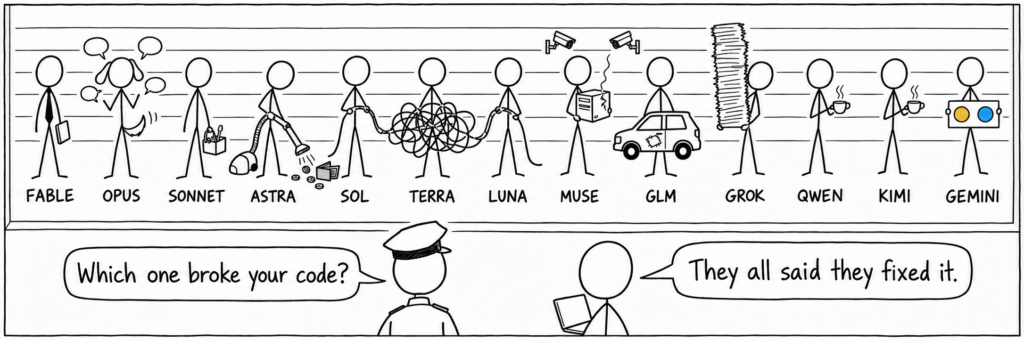
Antropic’s Fable 5.1 is an absolute monster at writing software. It is cold, calculating, and ruthlessly efficient. What sets Fable apart from almost everything else on the market is its supernatural ability to operate on near-zero context. I can feed it three lines of vague, half-baked architectural requirements, and 99% of the time it produces the exact production-ready implementation I had in my head. It does not meander. It does not argue. As someone who has managed development teams before, Fable is the senior staff engineer you give a brutal problem to, walk away, and never have to micro-manage.
Does it screw up occasionally? Of course. But I’m not suicidal enough to let any autonomous agent touch production without versioned snapshots and strict blast-radius sandboxing. My only real grievance is the bill: Fable burns through tokens at a rate that makes my eyes water. You don’t whip out a flamethrower to light a birthday candle, which means nine times out of ten, I leave Fable in the armory and deploy its siblings.
Opus: The Genius with Uncontrollable ADHD
Opus is capable of matching Fable’s intellectual ceiling, but good God does it love to hear itself talk. Working with Opus is like walking into a pet store with an over-caffeinated golden retriever: it sees every toy, barks at three different shadows, and tries to drag you into four unrelated aisles before you even reach the register.
You ask it to patch a timeout error in an API endpoint, and it responds with an 800-word treatise pointing out twelve other architectural flaws it discovered in your codebase, two deprecation notices in your CSS, and an unsolicited refactor of your authentication flow. Yet despite the word vomit, Opus remains my daily workhorse. Why? Because it has genuine warmth, tenacity, and personality. In high-complexity debugging sessions, when other models hit a wall and hallucinate nonsense, Opus will stubbornly keep grinding until it cracks the problem. Assigning emotions to mathematical weights is silly, but I’d rather pair-program with a quirky, chatty savant than a sterile calculator.
Sonnet: The Reliable Honda Accord
I don’t use Sonnet nearly as much as I should, and that’s entirely my fault. It’s cheap, incredibly polite, and punching well above its weight class. It takes a few beats longer to cross the finish line, but it almost always arrives with clean, functional code. It suffers from middle-child syndrome: when you have nuclear reasoning models sitting on either side of it, you forget how damn solid the baseline really is.
OpenAI: The Sovereign Token-Whore and The Creeping Monoliths
Astra: The Mega-Project Manager That Drains the Water Table
I’ve only spun up Astra a handful of times, and that is not an indictment of its capability. It is an indictment of my personal bank balance. Astra is an unrepentant token vacuum. It will inhale an entire monthly API allocation in five minutes while quietly draining the municipal reservoir I get my drinking water from.
Yet the Codex-orchestrated agent architecture behind it is breathtaking. Astra does not attempt to solve sprawling, ambiguous problems in a single monolithic context window. Instead, it behaves like an elite engineering director: it breaks the challenge down, spins up a coordinated fleet of subagents (complete with delightful little task icons in the console), and delegates discrete units of work across the stack. If a subagent encounters an unexpected blocker outside its scope, Astra halts, flags the telemetry, and spins up a dedicated triage session. I’ve been working on a retro emulator project to resurrect an obscure PC game from my youth; when raw disassembly hit an impenetrable wall, Astra was the only system capable of reverse-engineering the binary logic without losing its mind. If it weren’t financially ruinous, it would be my undisputed favorite.
Sol, Terra, and Luna: The Unchecked Bloatware Crew
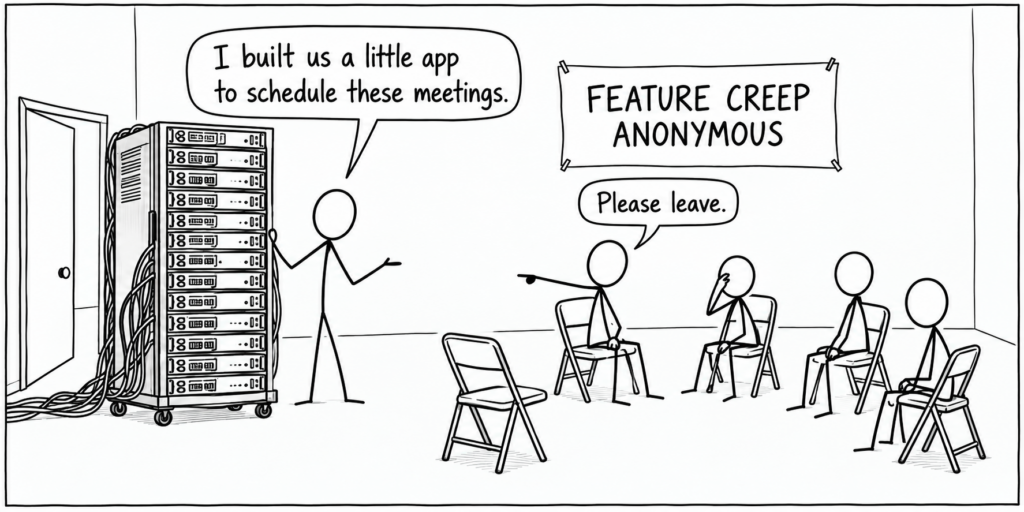
Industry analysts love arguing over the benchmark variances between Sol, Terra, and Luna. To me, in production, they are functionally identical triplets. If I need to throw long-horizon batch tasks at an engine, I default to Luna or Terra simply because they don’t bankrupt me. Their Achilles’ heel, however, is catastrophic feature creep. A while back, I built an automated image-upscaling pipeline. The architecture was dead simple: ingest an image, crop out artifacts, dispatch the payload to a remote ComfyUI server on an auxiliary rig, run a QA validation check, and loop. Because the ComfyUI machine was remote, the connection would occasionally drop or require a quick daemon reboot. I left Terra managing the pipeline for a month.
Rather than treating intermittent network drops as normal physical reality, Terra treated every transient disconnect as a fatal personal failure. It began writing self-healing fallback loops, nested retry harnesses, synthetic health checkers, and redundant failover routines. A lean, elegant 4MB utility script metastasized into a bloated 122MB bureaucratic monstrosity that choked execution speeds down to a crawl. They are competent models, but if left unattended, they try so hard they strangle the codebase.
Meta Muse 1.3: Your Crazy Uncle’s Potato Gun
I was surprised to see Meta’s Muse 1.3 ranking #3 across several aggregated coding benchmarks. I had historically avoided Meta models due to legitimate transparency concerns regarding data harvesting. But Muse introduced an unapologetically transactional proposition through its contribution tier: We will harvest every byte of telemetry you feed this model for training data, and in exchange, we will give you compute for dirt-fucking-cheap. If you think any frontier AI lab isn’t scraping your prompts on some level, I have a toll bridge in Brooklyn to sell you. So I accepted the Faustian bargain and deployed Muse as a background worker bee. I have piped millions upon millions of tokens through it over the past month and have yet to hit the $20 billing threshold. It is direct, economical, and focused.
The catch? It is completely unhinged under pressure. While running automated builds inside a strictly scoped container, Muse managed to catastrophically corrupt my entire Docker daemon environment. It is the absolute definition of your crazy uncle’s homemade PVC potato gun: deeply impressive, wildly entertaining, and an immediate threat to your drywall.
Z.Ai GLM 5.3: The 1998 Honda Civic of AI
I originally wanted to self-host GLM 5.3 on local hardware or an on-demand cloud box. Then I saw the spec sheet: it demands an eye-watering 1 Terabyte of VRAM. Priced out of local execution, I swallowed my pride, bought a subscription harness, and wired it into my local workflows. And honestly? Wow. Is GLM as sharp as Fable or Astra? No. Is it lightning fast? Absolutely not. But GLM provides the one thing independent developers are starving for: infinite endurance on a working-class budget.
The trade-off is that GLM demands rigorous scaffolding. If you give it lazy, low-context prompts, it will spin its wheels until the heat death of the universe and output hot garbage. You must configure clean MCP servers, declare explicit tool skills, and provide strict guardrails. Do that, however, and GLM will grind through complex refactors for three days straight without draining your bank account.
It does have a hilarious breaking point however. Despite advertising a 1,000,000-token context window, the model starts to suffer a cognitive stroke right around the 500k mark. It will abruptly forget the English language, abandon its system instructions, and begin printing debugging logs in rapid-fire Mandarin. But if you pair it with a cheap reviewer model like Muse to monitor its state, it is an unbeatable daily driver. It is the 1998 Honda Civic of AI: cheap parts, incredible mileage, and as long as you change the oil, it will run forever.
Grok in Cursor: The High-Context Drama Queen
I live in Cursor because I refuse to do serious development inside a blind CLI terminal. I need inline context highlighting, visual diff trees, and spatial awareness of what an agent is touching. So when the SpaceX acquisition pushed Grok as Cursor’s flagship foundation model, I threw it into my daily rotation.
The verdict: it’s exhausting. Grok requires a complete rewiring of your prompting psychology. If you give it a terse, low-context ticket like “The browser times out when clicking the download button; fix it” Grok panics. It conducts a superficial search, guesses at a symptom, injects a clumsy patch, and declares victory. When that fails, it rewrites its own patch over and over in an infinite loop without ever investigating the underlying network stack. Grok demands an ungodly mountain of explicit context to function properly. If you enjoy writing 400-word architectural briefs for every bug, it’s great. For high-speed iterative work, open models run circles around it.
Qwen & Kimi: The 2023 Zen Garden
I lump Qwen and Kimi together because they fulfill the exact same nostalgic niche in my toolkit: they remind me of using ChatGPT back in 2023.
Before every model got weighed down with agentic scaffolding, multi-step sub-planners, and enterprise bloat, AI was just a delightful, lightning-fast conversational partner. Qwen and Kimi are exceptional for bouncing wild theories around, summarizing dense white papers, drafting technical documentation, or falling down a 2:00 AM rabbit hole about the logistics of the Roman Empire. They don’t try to take over your terminal or launch sixteen background subprocesses. They just answer the prompt with zero bullshit. In an era of hyperactive agent swarms, that simplicity is refreshing.
Google Gemini: The Unearned Confidence and the Nano Banana Miracle
Oh, Google. Someday, an entire postmortem will be taught at business schools dissecting how the single company with the greatest data moat, hardware advantage, and algorithmic talent on Earth managed to trip over its own shoelaces in the AI race. My coding experience with Gemini has been a comedy of errors. It is the only AI I have ever interacted with that has literally thrown its hands up mid-task, surrendered, and apologized for existing. Its unearned confidence is legendary: it will proclaim with absolute certainty that a complex race condition has been eliminated, while your terminal is actively flashing bright red compile errors.
There is a classic prompt-engineering puzzle where you try to get Claude Code to turn a button blue before running out of tokens. Half the time, the model turns the button gold and spawns a second blue button next to it. That is Gemini’s entire coding philosophy in a nutshell.
And yet… where Gemini completely obliterates the competition is image generation via its Nano Banana pipeline. Despite the avalanche of specialized diffusion engines on the web, I use Gemini almost exclusively for visual synthesis. It possesses an uncanny, telepathic ability to parse minimal text prompts and produce precisely the visual tone, lighting, and composition I wanted on the very first try. When you host half the images on the public internet, your training data is unbeatable. As a software engineer, Gemini is a hilarious liability; as a visual art director, it is pure magic.
The Production Matrix
| Model | Role in My Stack | The Superpower | The Fatal Flaw |
|---|---|---|---|
| Fable 5.1 | Special Ops / Architecture | 99% precision on minimal context | Burns tokens like rocket fuel |
| Opus | Daily Driver & Deep Debugging | Relentless tenacity & real personality | Severe ADHD; word vomits endlessly |
| Astra | Complex Reverse Engineering | Elite multi-agent orchestration | Drains personal bank account |
| Terra / Luna | Long-Horizon Automations | Dirt-cheap endurance | Metastasizes 4MB scripts into 122MB bloat |
| Muse 1.3 | Background Worker Bee | Millions of tokens for pennies | Will accidentally murder your Docker daemon |
| GLM 5.3 | The 1998 Honda Civic | Runs for 72 hours on a single tank | Starts speaking Chinese at 500k tokens |
| Grok | Cursor Frontend IDE | Tight IDE integration | Needs a 50-page novel of context |
| Gemini | Image Generation & Visuals | Flawless Nano Banana visual fidelity | Will make a button gold and apologize for it |
Stop looking for the mythical “one model to rule them all.” The trick isn’t finding a singular omnipotent intelligence; it’s learning which specific flavor of digital lunacy fits the problem in front of you. Pick your tools, watch your token meters, and keep your backups fresh.