“Windows 11 setup is no longer an operating system installation. It is a digital timeshare presentation where you are held captive until you decline Microsoft 365 four consecutive times.”
— Overheard at Defcon
I know I bash Microsoft a lot. I do it constantly, and usually without mercy. But I need to get something off my chest right at the top of this piece: I do it out of love.
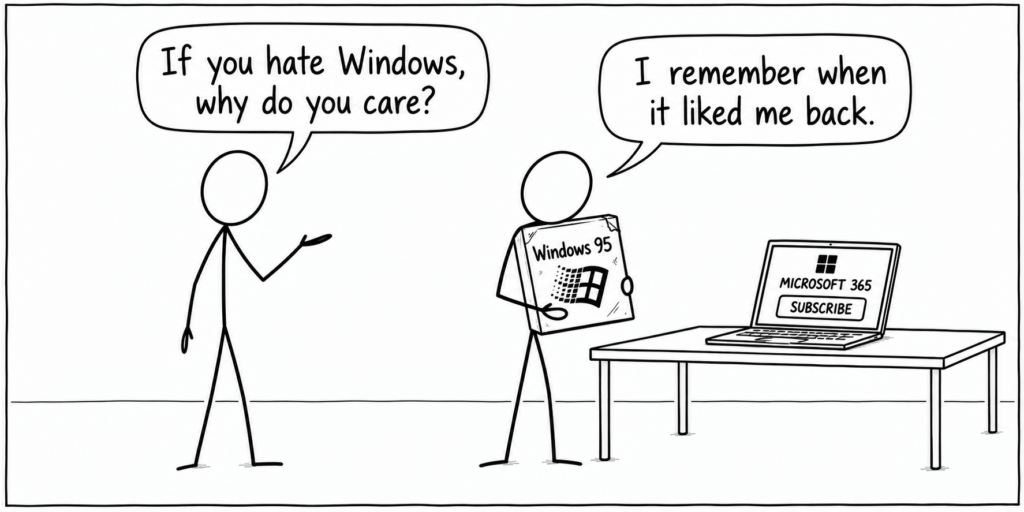
Windows was the very first operating system I ever touched. It was the digital sandbox where I learned what a directory was, where I edited my first bat file, and where I spent thousands of childhood hours falling head-over-heels in love with computing. I don’t want Microsoft to fail. I want Windows to be great again. I want it to be the rock-solid, unpretentious, universal computing workhorse that conquered the world in the first place.
Which is why what Microsoft has done to Windows 11 breaks my goddamn heart.
The Out-of-Box Hostage Situation
In my daily life, I am almost entirely a Linux and macOS user now. Modern Linux compatibility layers like Proton and Wine have gotten so ludicrously good that 95% of the time, I can run whatever Windows binary I need without ever touching Redmond’s kernel. But last week, I was reverse-engineering an obscure piece of legacy software for a retro project, and it demanded an authentic, native Windows environment. Fair enough.
I spun up a virtual machine, downloaded a pristine Windows 11 installation ISO, mounted the image, and hit enter. I knew the modern Windows Out-Of-Box Experience (OOBE) had degenerated over the last few years. I knew Microsoft was aggressively nudging users toward cloud accounts. But holy hell, I had no idea it had degraded into an aggressive, late-night telemarketing ambush.
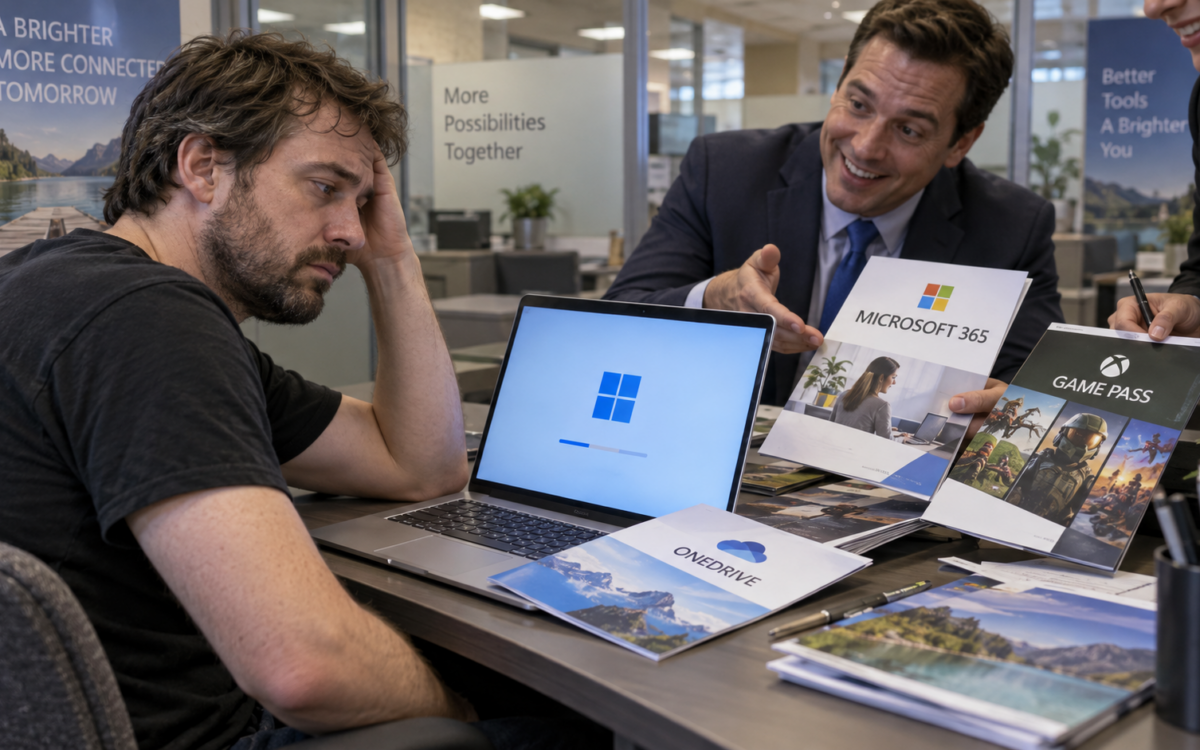
Before I was allowed to set eyes on a functional desktop, the installer subjected me to the following gauntlet of digital extortion:
Forced Microsoft Account Login: No local offline accounts allowed. If you don’t know obscure terminal bypass tricks like OOBE\BYPASSNRO, your machine is bricked until you surrender an email address.
Facial Recognition / Windows Hello Setup: Hand over your biometric telemetry immediately.
Diagnostic and Telemetry Consent: Five consecutive toggle screens politely asking for permission to monitor your keystrokes, location, and application usage.
OneDrive Cloud Storage Pitch: Let us back up your documents to Azure before you even have documents.
The Microsoft 365 Shakedown (Round 1): Buy Office right now!
The Microsoft 365 Shakedown (Round 2):“Are you sure you don’t want Office 365? Look at these templates!”
The Microsoft 365 Shakedown (Round 3):“How about Microsoft 365 Basic? It has a cloud tier! You can use it for free for 30 days!”
Xbox Game Pass Upsell: Hey, we know you’re spinning up an enterprise VM, but do you want to play Halo?
Cortana / Copilot Resurgence: Just in case you weren’t sure, please enable our AI assistant so it can hover over your taskbar forever.
I felt like I had walked onto a sleazy used car lot to buy a replacement tire and ended up trapped in a glass cubicle with a salesman sweating through his polyester shirt, begging me to finance an extended undercoating warranty. I just wanted an operating system. I did not ask for a revolving subscription buffet.
The Frankenstein Desktop: XP Bones and Copilot Bloat
Once you finally survive the onboarding interrogation and cross the threshold to the desktop, the corporate harassment doesn’t stop. It just changes shifts.
Every time you launch Edge to download a real web browser, Windows grovels like a desperate ex-partner: “Edge is built on the same technology as Chrome, are you SURE you want to switch?” Copilot slides into the sidebar uninvited, chewing up cycles. Popups periodically remind you that your local files aren’t synced to OneDrive. It is exhausting.
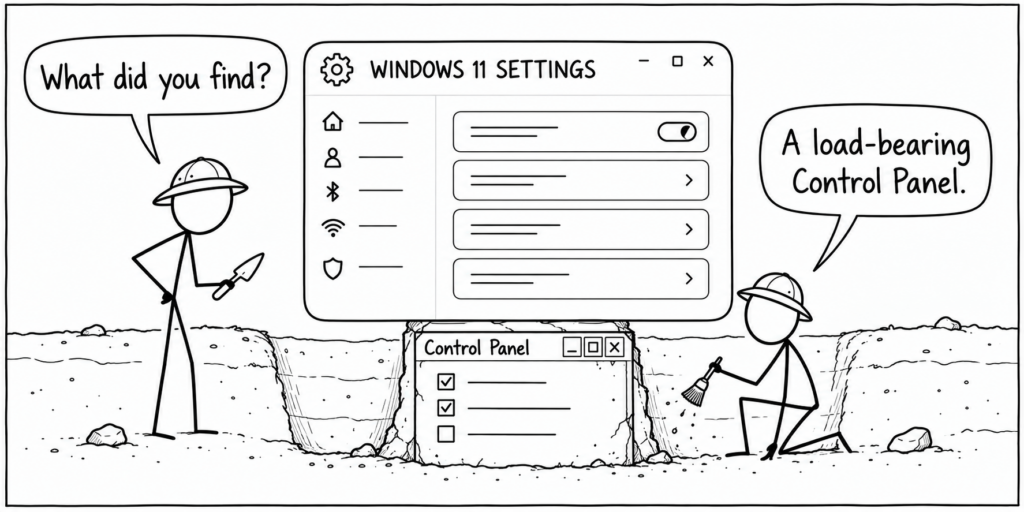
And beneath that slick, frosted-glass “Fluent Design” paint job lies an absolute architectural disaster. Windows 11 isn’t a cohesive operating system; it is a Winchester Mystery House of legacy technical debt. You click a network setting in the modern pastel interface, click “Advanced Properties,” and boom: you are suddenly looking at an un-themed dialog box ripped straight out of Windows 2000. Double-click an audio device, and you’re staring at an MMC snap-in from Windows XP. There are currently four distinct paths to manage audio peripherals in Windows, and each one takes you to a different archaeological layer of Microsoft’s UI history.
Then there is the sheer, suffocating bloat. These days, vanilla Windows 11 can barely breathe in an 8GB RAM environment. If you leave Copilot and background telemetry enabled, the OS idles like a cryptocurrency mining rig. Whenever I am forced to install Windows today, my very first step is running third-party debloating utilities like AtlasOS or ReviOS just to strip out the pre-installed adware, purge the background trackers, and reclaim 4GB of hijacked memory. The fact that the enthusiast community has to maintain custom open-source ROM-style amputations of Windows just to make it run like a normal OS should be an existential embarrassment for Redmond.
The 12% Orphan: When the Golden Goose Dictates the Tail
Why is this happening? Because if you look at Microsoft’s earnings reports, the truth is laid bare in cold, unforgiving financial telemetry: Windows accounts for roughly 10% to 12% of Microsoft’s total revenue. And that slice continues to shrink every fiscal quarter.
Windows is no longer the business. Cloud is the business. Azure is the business. Commercial Office 365 licensing is the business. And when your core operating system gets demoted to a single-digit revenue footnote, management stops treating it like a standalone engineering masterpiece and starts treating it like a monetization funnel. A digital billboard designed to funnel human beings into recurring cloud MRR.
With Microsoft’s Xbox division in disarray and corporate priorities drifting with every quarterly earnings call, Windows suffers from the same fatal sickness plaguing most modern Microsoft products: a complete and total absence of architectural direction.
Microsoft does not have a long-term vision; it has market-fad reflex spasms. Whenever a new buzzword sweeps Silicon Valley, executive leadership grabs a paintbrush, slaps the buzzword onto Windows, renames six enterprise portals, and shuffles the deck chairs. Look at AWS: the path to provision an S3 bucket or spin up an EC2 instance is fundamentally the same reliable, boring workflow it was seven years ago. AWS understands that enterprise infrastructure demands stability.
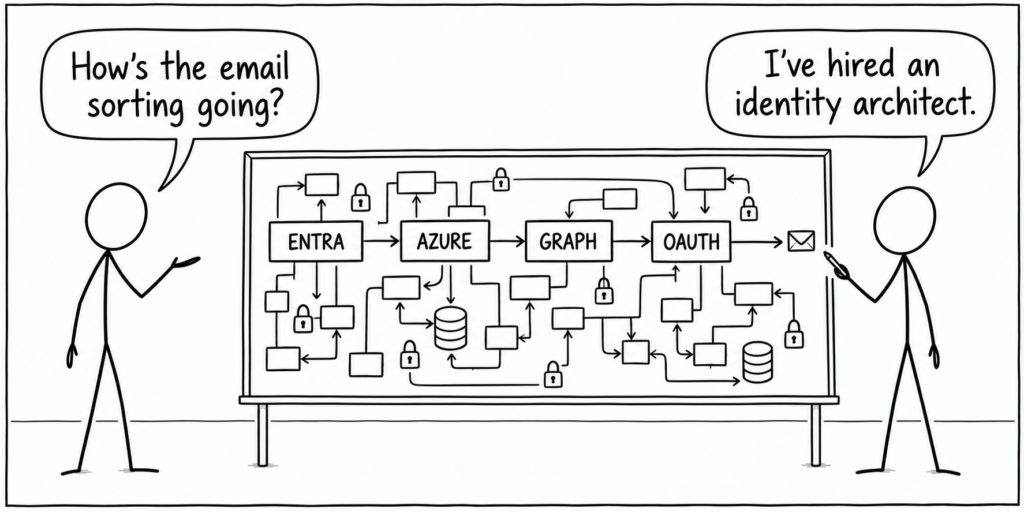
Now look at Microsoft. Last week, I had a simple goal: I wanted an AI assistant to connect to my Outlook inbox to help sort incoming mail and write triage rules. In a sane ecosystem, you click “Authorize Plugin.” What did Outlook demand?
Outlook informed me that to allow an API to touch my emails, I needed to log into a Microsoft Entra tenant (which used to be Azure Active Directory before someone got promoted for renaming it), provision a Microsoft Graph API OAuth client credential token, configure scopes, and link them through an Azure enterprise portal. To sort my emails. What the hell is an Entra? Is it a Hyundai sedan? What happened to the old portal?
The Pincer Movement: Valve on the Flank, Apple at the Gate
While Microsoft sits back, reaps its astronomical cloud margins, and neglects the desktop experience, the rest of the industry is systematically carving up whatever market share remains.
On the consumer and gaming front, Valve has executed the single most impressive flank in modern computing history. By investing relentlessly in Proton and SteamOS, Valve proved that PC gaming doesn’t need Windows. Gaming on Linux isn’t an obscure command-line science project anymore; with the Steam Deck and modern desktop distributions, it is a fast, smooth, bloat-free experience that doesn’t interrupt your session to pitch you cloud backup subscriptions.
Meanwhile, in the enterprise sector, the historic fortress of the Windows domain, Apple Silicon is staging a bloodless coup. Walk into any high-growth tech startup, engineering firm, or modern corporate office today and you will see. When HR hands a new hire their equipment requisition sheet, an overwhelming majority of developers and knowledge workers are requesting a MacBook. They don’t want to deal with 974 Patch Tuesday updates. They don’t want their laptop fans screaming because Copilot is indexing their telemetry. They want a Unix shell, fifteen hours of battery life, and an OS that doesn’t treat them like a captive audience.
The Unsolicited Recommendation: If It Ain’t Broke, Don’t Fix It
Microsoft will survive this rant. They are a multi-trillion-dollar behemoth with enterprise lock-in that will outlive us all. But if anyone in Redmond still possesses an ounce of the romantic engineering passion that built MS-DOS and Windows 95, here is my humble, earnest plea:
If it ain’t broke, stop “fixing” it.
Stop reinventing your user interfaces every eighteen months. Stop renaming your cloud portals to hit executive OKRs. Pull the telemetry tracking, the predatory dark-pattern subscription nags, and the forced online accounts out of the installer. Strip the bloat down to the bone. Give us a clean, lightning-fast, modular foundation that respects user agency and gets out of the way.
We are living in an era where generative AI and modern compilers have lowered the barrier to software creation to near-zero. Millions of new creators are deciding where to build their tools, stake their projects, and write the next generation of code. Don’t you want them building on Windows?
Take a lesson from AWS, from Google, and from Apple: true progress isn’t erratic cosmetic churn. True progress is disciplined, quiet, incremental polish. Stop shouting at us through the installer. Just let Windows be an operating system again.